Freedom is merely a philosophy.
We are not people in the capital, we are bodies.
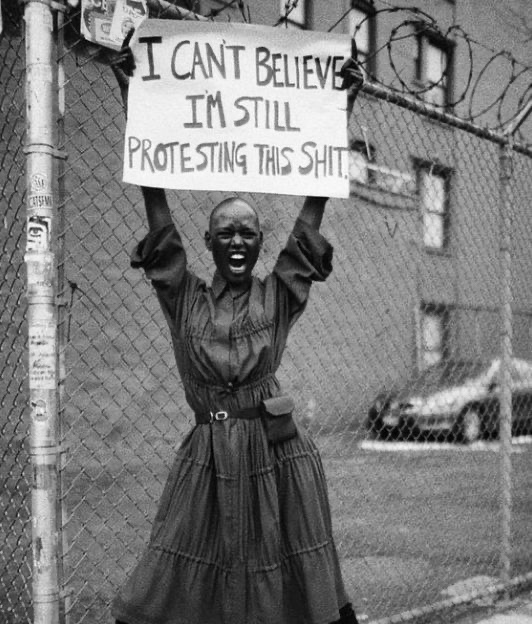
…
Do you know how it feels to be in fear of your life every day?
Do you know how it feels to walk into a new space and wonder if they’ll accept you? Is that space built for you?
Are they surprised when you sound British?
Do you try to prove your Britishness to your white counterparts to show that you also belong?
The displacement, the diaspora, the dire state of identity. That ultimate feeling of the unknown within your own body is filtered with more criticism of your place in the Global North. Our bodies were ripped apart from their roots and placed into categories that decided who we were before we could decide for ourselves.
Black people in particular face a rather peculiar ridicule where their culture is profited off through the music, fashion and beauty industry. A paradox exists where black culture is appropriated heavily, yet discriminated against when embodied by black people themselves.
…
History has profited off enslaved bodies for a corrupt system forming the basis of racial capitalism… (and breathe!) By this, I mean that enslaved people were used to build the Global North through free labour. This has founded the way the modern world uses minorities/POC for cheap labour to maximise profit as well. Now, I’m not here to give anyone a history lesson on colonialism, imperialism and decolonisation (I’d end up writing a very messy book), but I am here to talk about the Black Lives Matter Movement and what it means for the future.
With the catalyst of George Floyd’s infamous video circulating the media, it has sparked real momentum for destruction and re-birth.
However, we must be clear about one thing. Categorising decolonisation as a ‘riot’, ‘unruly’ or ‘unhelpful’ is a powerful tactic to make the people involved look irrational or angry. The UK is very successful in making people look ludicrous in their response to institutional racism. It really is the oldest trick in the book.
…
Another tactic taken to undermine the importance of the movement is the terrible term: ‘All Lives Matter’. ‘ALM’ is a harmful way of stating that the BLM movement says that only Black Lives Matter.
For centuries the white man has dehumanised, demonised, objectified and exploited the lives of black people globally. This can be seen from the colonisation of Africa, to the transatlantic slave trade, to incarceration rates and police brutality. Now, this is not to say that injustices based on race are only a reality for black people… this happens around the world. However, in the context of black lives this particular group of people find themselves demonised in almost all societies and cultures. We are simply stating that for this particular group, things drastically need to change. Think to yourself if you’re a believer in ‘ALM’… what am I really saying here? Am I not acknowledging that racism exits? Do I want to pretend it doesn’t because the guilt and shame is too much?
(Whether this sparks momentum for other minorities to demand justice is another matter.)
A revolution is uncomfortable. A revolution is loud. A revolution asks us to confront the perpetuation of death.

…
Sandra Bland
Breonna Taylor
Kathryn Johnston
Korryn Gaines
Tanisha Anderson
“Just as racism is ingrained into our society, so is misogyny meaning society is more ready for the liberation of black men than that of black women.” Jummy, 22
We must centralize the experiences of black women within this racial pandemic too. As an Indian woman I understand I cannot speak for my black-women counterparts, so I have asked my black-female friends to speak their truth.
…
‘I’ve been fortunate enough to have be brought up to know that my race will always affect my life, how I’ll be treated/seen by others and how to deal/manage certain behaviors or treatment towards me etc.. whilst I appreciate that the “movement” or “protests” have finally shed some light on the extent of the hardships experienced by black people (the fact that I’m a Jehovah’s Witness – and Jehovah’s Witnesses don’t protest) means my religion also limits the extent to which I can say the movement has affected me. I also know the “movement” has been pushed by a lot of non-black/white people who often times behind closed doors don’t give a damn about black lives – so in terms of answering the question- when u ask about how the movement has made me feel- it’s a lot more than just feeling – it’s about experience and heavily linked the reception/actions of others.’
Camille, 21
Race is a layer of oppression that cannot be brushed aside as another tick box. This layer has some perplexing yet rigid forms. It’s flexible and it’s class based, but it’s also accent based, generation based… gendered.
Colourist, yet pretty much black and white.
…
‘Whenever I hear criticisms surrounding the BLM movement, or surrounding black women fighting to be heard, it feels like a personal attack. And it is. Race and gender form part of our identities, and in many cases can be the bulk of our identities. I am a black woman. This is what I identify as and this is what has a great impact on my life, both positive and negative. Society has created systems which rely heavily on racial and gender identity, and sometimes it can feel as if these are the only parts of our identity that really matter. But identity is complex, multi-layered and individual. Yes, I am a black woman, but I am so much more than that. There are several things that make up who I am, and I think it is important not to lose sight of those other things especially at a time like this. Whether it be my hobbies or my relationship, I find it important to keep these things in mind so as not to be consumed by the burden society has placed on my racial and gendered identity.’
Jummy, 22.
Destruction and re-birth is so much more than diversity schemes, it’s to stop black women from being subject to judgment that has been socially constructed. They do not have ownership over their stereotype, but they have to embody that stereotype and live with the consequences.
…
‘One of the biggest, if not the biggest, problems within the movement is intersectionality. Put simply: the movement currently only serves straight black men. We can see this clearly in the contrasting responses to the deaths of George Floyd and Breonna Taylor. The response to George Floyd was strictly a demand for justice, with the result that his killers have been charged for his murder. However, Breonna’s death has been turned into a meme with people making TikTok sounds regarding her death or turning the scene of the crime into a spread in a fashion magazine.’
‘The issue isn’t necessarily a lack of representation of black women in the movement; on the contrary, black women have been spearheading the movement since the Civil Rights era. The issue is the lack of respect for these women, their ideas and their demands… Black men have very much taken advantage of this prospect and decided to place their demands at the forefront. And whilst black women fight tirelessly to aid in the liberation of black men, who is fighting for us?’
Jummy, 22
…
‘Do I think there’s enough representation for black women? Answer: it depends. What are the circumstances ? Is it the political world, the fashion/beauty industry? The commercial world?
Because music /fashion HELL YES ! Black women and men dominate – Rihanna, Beyoncé , Cardi B, Winnie Harlow, Meg the stallion etc.. the list goes on. Whilst there may not be loads of black women on show- the few that are if I do say some myself “REPRESENTTT”, more could be done in the beauty industry and fast fashion however! Politically no- not in the uk anyway- and if there is representation it’s always in a negative light e.g David Lammy and Diane Abbot.’
Camille, 21

Realising we are the way we are because of external factors is an ultimately strange feeling. The social construction of our identities determine our life path. Who we are, what we believe, what we eat are either commodified or discriminated against.
Black women; the gendered & racialised abuse cannot be quantified. From histories of slavery, sexualisation and commodification I cannot express the sheer anger in my body for the lack of prioritisation.
I question what it says about society when legitimate anger is demonised and criminalised yet racism is not. How many people have ended up behind bars for being racist? And how many people have ended up behind bars for being anti-racist? Nelson Mandela spent 26 years behind bars and was the victim of a smear campaign led and supported by white supremacists across the globe. This includes our very own Margaret Thatcher who spent many years labelling him a terrorist for opposing white supremacy .
Explaining how it feels to be woman of colour is like banging your head against a brick wall. But rather than explaining how it feels over and over again, it’s time for real time decolonisation.
It’s time for destruction and re-birth.
…
Below I have included Jummy’s full piece she sent to me… have a read!
The Black Lives Matter Movement is not a new feat but following the recent death of George Floyd there has been a large explosion in both the discussion and action surrounding the movement. When I first saw this explosion, I felt very excited. Racism is something that has always been a part of my life, and something that I could always use as a means of relating to other black people. So, the attitude of ‘enough is enough’ initially instilled in me a sense of hope that change was close. However, this hope was soon diminished as the reality of the system we are fighting sunk in. Between systems that were created in order to disfavour black people, to the performative allyship of those with the power to enact change, it became debatable whether change was likely. However, I still believe that if we should loud enough, and keep shouting for a prolonged period of time, our voices must be heard.
As well as external factors that negatively affect the movement, I think it is equally if not more important to analyse the movement itself. One of the biggest, if not the biggest, problems within the movement is intersectionality. Put simply: the movement currently only serves straight black men. We can see this clearly in the contrasting responses to the deaths of George Floyd and Breonna Taylor. The response to George Floyd was strictly a demand for justice, with the result that his killers have been charged for his murder. However, Breonna’s death has been turned into a meme with people making TikTok sounds regarding her death or turning the scene of the crime into a spread in a fashion magazine. Yet, we are still awaiting the arrest of her killers. The issue isn’t necessarily a lack of representation of black women in the movement; on the contrary, black women have been spearheading the movement since the Civil Rights era. The issue is the lack of respect for these women, their ideas and their demands. Just as racism is ingrained into our society, so is misogyny meaning society is more ready for the liberation of black men than that of black women. Black men have very much taken advantage of this prospect and decided to place their demands at the forefront. And whilst black women fight tirelessly to aid in the liberation of black men, who is fighting for us?
I don’t think anymore can be done to understand the combined gendered and racial abuse: coined misogynoir. Black women have been talking about how the movement isn’t serving their needs. Books have been written concerning this topic. Videos have been released. Articles have been published. The information is very much readily available for people to understand, yet they refuse to listen. I think it’s time for black women to start being more selfish and place their own needs above those of others. Black men tend to easily guilt trip us into prioritising them and we have come to be viewed as saviours. But, sadly, no one else is willing to do the same for us. Therefore, we must be ready to do this for ourselves, even if it is at the expense of others.
Whenever I hear criticisms surrounding the BLM movement, or surrounding black women fighting to be heard, it feels like a personal attack. And it is. Race and gender form part of our identities, and in many cases can be the bulk of our identities. I am a black woman. This is what I identify as and this is what has a great impact on my life, both positive and negative. Society has created systems which rely heavily on racial and gender identity, and sometimes it can feel as if these are the only parts of our identity that really matter. But identity is complex, multi-layered and individual. Yes, I am a black woman, but I am so much more than that. There are several things that make up who I am, and I think it is important not to lose sight of those other things especially at a time like this. Whether it be my hobbies or my relationship, I find it important to keep these things in mind so as not to be consumed by the burden society has placed on my racial and gendered identity.
SilverJay, BSc Sociology LSE
 Silver Jay
Amazing article. Well done
LikeLike